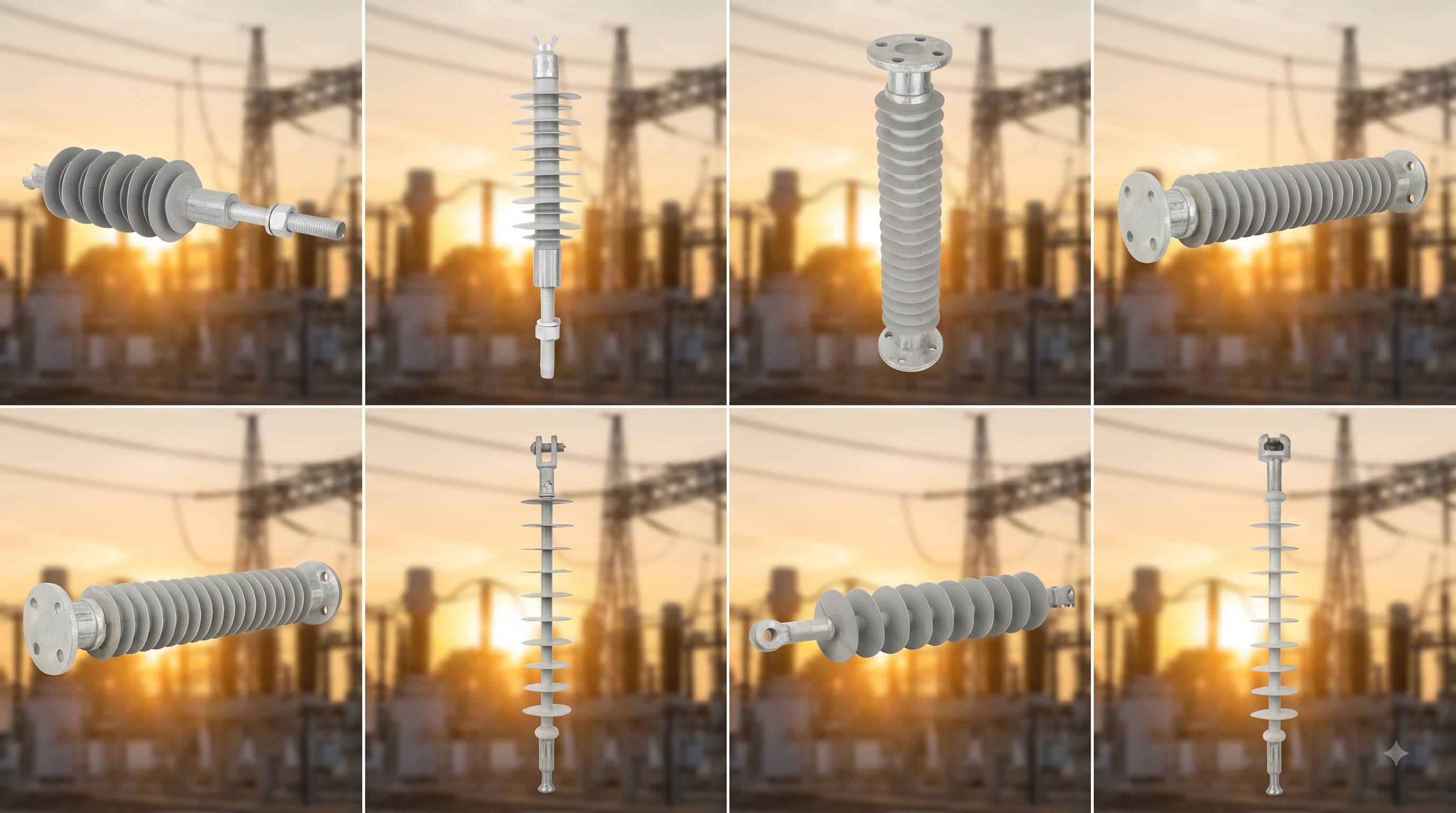
Polymer Insulators Explained: Disc, Post & Pin Types, Construction, Ratings and Applications
Modern electrical transmission and distribution networks require insulators that can provide reliable electrical insulation while also withstanding mechanical loads, pollution, rain, dust and changing outdoor conditions.
One widely used solution is the polymer insulator, also known as a composite insulator or silicone rubber insulator.
Polymer insulators are used across distribution lines, transmission lines, substations, railway electrification systems, switchgear and other high-voltage installations. International standards recognize composite insulators for overhead-line suspension/tension applications, line-post applications and station-post applications.
The three important categories discussed in this article are:
Although all three perform the basic job of electrically isolating an energized conductor from an earthed structure, their construction, mechanical duties, mounting arrangement and applications can be very different.
What Is a Polymer or Composite Insulator?
A typical composite insulator consists of three important elements:
1. FRP Core
At the centre of the insulator is a high-strength fibre-reinforced polymer or glass-fibre reinforced resin rod, commonly called an FRP rod.
This core provides much of the mechanical strength required to support conductors and withstand tensile, bending or other mechanical loads depending on the type of insulator.
2. Silicone Rubber / Polymer Housing
The FRP core is protected by an external polymer housing with multiple sheds.
Silicone rubber is widely used for this purpose. The sheds increase the surface leakage or creepage path between energized and grounded ends of the insulator.
Silicone-based housings can also provide useful hydrophobic behaviour, helping the surface resist continuous water-film formation under wet conditions. Commercial composite-insulator designs commonly combine a fibreglass rod, polymer housing and metal end fittings.
For the product range discussed here, the polymer housing is generally grey in colour.
3. Metal End Fittings
Metal fittings are attached to one or both ends of the FRP rod.
Depending on product design and customer specification, these may be manufactured from materials such as:
- Spheroidal Graphite Iron / SG Iron
- Ductile Iron
- Forged Iron or Forged Steel
- Other approved metallic materials
For outdoor applications, suitable corrosion protection such as galvanizing may also be required.
The combination of the FRP core, silicone rubber housing and mechanical end fittings creates a lightweight but mechanically strong high-voltage insulating component.
Why Are Polymer Insulators Used?
Compared with traditional insulating technologies, composite construction can provide several practical advantages for suitable applications.
These can include:
- Lower overall weight
- Easier transportation and handling
- High mechanical strength-to-weight ratio
- Flexible shed/profile design
- Good performance in contaminated environments when properly selected
- Suitable designs for transmission and distribution applications
- Reduced breakage risk during normal transportation compared with brittle ceramic components
- Different end-fitting configurations for different structures
Polymer insulators are now used across distribution and transmission voltage levels in many parts of the power industry.
However, the correct insulator cannot be selected only by looking at voltage. Mechanical loading, creepage distance, pollution level, installation method, end fittings and applicable standards are equally important.
1. Polymer Disc Insulator
A Polymer Disc Insulator is commonly used as a commercial term for composite suspension and tension/strain insulators.
Unlike a conventional porcelain or glass disc unit, a composite suspension/tension insulator usually has a continuous FRP core covered by polymer sheds, with mechanical fittings attached at its ends.
For a focused explanation of suspension and tension arrangements, mechanical ratings, creepage and end fittings, read the Polymer Disc Insulator selection guide.
[IEC 61109] covers composite suspension and tension insulators for overhead-line applications, while [IEC 61466-1] addresses composite string-insulator units and standardized coupling arrangements.
Voltage Range
Polymer disc/suspension insulators can be designed for different voltage classes.
Depending upon system design, customer requirement and product specification, configurations may include:
11 kV, 22 kV, 33 kV, 66 kV, 120 kV, 220 kV, 440 kV and other voltage classes.
The buyer should distinguish between:
- Nominal/rated system voltage
- Highest system voltage
- Working/service voltage
- Power-frequency withstand voltage
- Lightning impulse withstand voltage
These terms should not automatically be treated as the same value.
Mechanical Strength of Polymer Disc Insulators
One of the most important characteristics of a suspension or tension insulator is its mechanical/tensile strength.
Typical product requirements may include mechanical classes such as:
- 45 kN
- 70 kN
- 90 kN
- 120 kN
- 160 kN
Important Technical Point
These kN values are mechanical or tensile strength ratings. They are not electrical current ratings.
For example, a 70 kN Polymer Disc Insulator refers to its specified mechanical load capability according to the applicable design/test requirements; it does not mean 70 kA or 70 A current carrying capacity.
The actual mechanical class must be selected according to conductor load, span, tension, wind load, structure configuration and utility/EPC specification.
Creepage Distance in a Polymer Disc Insulator
Creepage distance is the distance measured along the insulating surface between the energized and earthed ends of an insulator.
Depending on the voltage level, shed profile and required pollution performance, polymer insulators may be manufactured with creepage distances such as:
- 25 mm/kV
- 31 mm/kV
- 35 mm/kV
- Or considerably higher values for higher-voltage designs as per requirements
The important point is that creepage distance cannot be selected from voltage alone.
Environmental conditions matter.
Areas with higher contamination such as industrial pollution, coastal salt deposits, dust or other environmental contaminants may require a different creepage design compared with a cleaner environment.
Therefore, the customer should always communicate the required creepage distance or applicable utility specification when requesting a quotation.
End Fittings of Polymer Disc Insulators
Different structures and line hardware require different end connections.
Common configurations supplied according to requirement can include:
- Tongue & Clevis
- Ball & Socket
- Tongue & Tongue
- Tongue & Hook
- Other customized or standardized arrangements
[IEC 61466-1] includes several recognized coupling styles for composite string insulators, including ball, socket, tongue and clevis arrangements.
Correct end-fitting selection is essential because the insulator must mechanically integrate with the tower, conductor hardware or supporting structure.
Applications of Polymer Disc Insulators
Polymer suspension/tension insulators may be used in:
- Electrical transmission lines
- Distribution networks
- Substations
- 33 kV lines
- Suspension locations
- Tension/strain locations
- Utility projects
- EPC power projects
- Industrial electrical networks
The final product specification must always match the mechanical and electrical requirements of the particular installation.
2. Polymer Post Insulator
A Polymer Post Insulator performs a different job from a suspension/tension insulator.
Instead of hanging a conductor primarily under tensile load, a post insulator generally provides rigid mechanical support while maintaining electrical separation between an energized component and an earthed structure.
For a detailed treatment of line-post and station-post construction, SCL, cantilever strength, creepage, PCD and mounting, read the Polymer Post Insulator Guide.
[IEC 61952] applies to composite line-post insulators for AC overhead lines above 1,000 V and also covers similar designs used in substations or electric traction lines. Composite station-post insulators have separate requirements under the [IEC 62231] series.
Types of Polymer Post Insulators
Depending upon application, post insulators may generally be categorized as:
Polymer Line Post Insulator
Used for supporting conductors on overhead distribution or transmission structures.
Polymer Station Post Insulator
Used in substations and electrical equipment where rigid support and electrical insulation are required.
Polymer Busbar Post Insulator
Used to support energized busbars in substations, panels, switchgear and related electrical systems.
Important Specifications of a Polymer Post Insulator
When selecting a post insulator, buyers should consider parameters such as:
- Rated voltage
- Highest system voltage
- Creepage distance
- Dry arcing distance
- Cantilever strength
- Bending strength
- Torsional requirements where applicable
- Overall height
- Shed diameter
- Mounting arrangement
- Base dimensions
- Pitch Circle Diameter or PCD
- Top fitting
- Bottom fitting
- Pollution conditions
- Applicable standard
Unlike suspension/tension insulators, where tensile strength is often a primary parameter, post insulator selection frequently depends heavily on cantilever and bending performance.
Station post designs can be subjected to cantilever, torsional, tensile and compressive loads depending on equipment and installation configuration.
Applications of Polymer Post Insulators
Polymer post insulators can be used for:
- Busbar support
- Substations
- Distribution structures
- Overhead lines
- Electrical panels
- Isolators and disconnecting equipment
- Switchgear
- Outdoor electrical equipment
- Industrial power installations
For example, a customer requiring a 33 kV Polymer Post Insulator should not simply request "33 kV post insulator."
The specification should preferably include:
33 kV + required mechanical strength + creepage distance + height + PCD + mounting type + end arrangement + application.
This reduces the chances of supplying an electrically suitable but mechanically incompatible product.
3. Polymer Pin Insulator
A Polymer Pin Insulator is commonly associated with overhead electrical distribution systems.
It supports the conductor while insulating it from the pole, cross-arm or supporting structure.
Polymer pin-type designs typically use an FRP core with polymer housing/sheds and appropriate metallic mounting hardware.
Voltage Classes of Polymer Pin Insulators
Common distribution applications can include:
- 11 kV Polymer Pin Insulator
- 22 kV Polymer Pin Insulator
- 33 kV Polymer Pin Insulator
Actual specifications vary between utilities and applications.
For example, an official MSEDCL specification for polymer pin insulators used with horn-gap fuse equipment specifies creepage distances of 320 mm for 11 kV, 560 mm for 22 kV and 900 mm for 33 kV, with minimum failing loads of 5 kN for 11 kV and 10 kN for 22/33 kV.
This is a useful illustration—but it should not be treated as a universal specification for every project.
Important Specifications for Polymer Pin Insulators
A buyer should consider:
- Rated voltage
- Highest system voltage
- Creepage distance
- Dry arcing distance
- Mechanical/cantilever strength
- FRP rod diameter
- Overall height
- Shed diameter
- Mounting or spindle arrangement
- End fitting material
- Housing material
- Applicable standard
- Installation environment
Typical applications include:
- Overhead distribution lines
- Electrical distribution networks
- Pole-mounted structures
- Horn gap fuse assemblies
- Utility distribution projects
- Industrial electrical distribution
Disc vs Post vs Pin Polymer Insulator
| Parameter | Polymer Disc | Polymer Post | Polymer Pin |
|---|---|---|---|
| Main Duty | Suspension / tension | Rigid support | Conductor support |
| Common Mechanical Requirement | Tensile load | Cantilever / bending | Cantilever / failing load |
| Typical Installation | Transmission & distribution lines | Lines, substations, busbars, equipment | Distribution lines |
| Mounting | End fittings | Base/top mounting | Pin/spindle mounting |
| Example Applications | Suspension, strain, transmission | Busbar, isolator, substation, line | 11/22/33 kV distribution |
| Housing | Composite silicone rubber/polymer | Composite silicone rubber/polymer | Composite silicone rubber/polymer |
| Core | FRP | FRP | FRP |
The exact construction and ratings depend upon the manufacturer's design and project specification.
What Information Should a Buyer Provide Before Ordering?
Simply writing:
"Need 33 kV polymer insulator"
is usually not enough information to identify the correct product.
For faster and more accurate technical selection, buyers, contractors and procurement teams should provide:
1. Voltage
Example: 11 kV / 22 kV / 33 kV / 66 kV / 220 kV
2. Type of Insulator
Disc / Suspension / Tension / Post / Line Post / Station Post / Pin
3. Mechanical Strength
Example:
5 kN, 10 kN, 45 kN, 70 kN, 90 kN, 120 kN or 160 kN, as applicable to the product.
4. Creepage Distance
Example:
320 mm / 560 mm / 900 mm / 1120 mm or project-specific requirement
5. End Fitting
For example:
Ball & Socket, Tongue & Clevis, Tongue & Tongue, Tongue & Hook
6. Application
Specify where the product will be installed:
Distribution line, transmission line, substation, railway, busbar, panel, isolator or other equipment.
7. Mounting Details
Especially important for post and pin insulators:
- Mounting type
- PCD
- Hole dimensions
- Base dimensions
- Top fitting arrangement
8. Applicable Standard or Tender Specification
If the material is being purchased for a utility, EPC project, railway project or government tender, providing the technical specification/GTP helps the manufacturer match the product correctly.
Why Specification Matters More Than Voltage Alone
Two insulators marked for the same voltage class can have very different:
- Mechanical strengths
- Creepage distances
- FRP rod diameters
- Heights
- End fittings
- Mounting arrangements
- Pollution performance
- Electrical withstand characteristics
Therefore, the right question is not simply:
"Do you have a 33 kV polymer insulator?"
A better enquiry is:
"We require a 33 kV polymer line-post insulator with the required cantilever strength, creepage distance, mounting dimensions and applicable utility specification."
That additional technical information helps both buyer and manufacturer avoid incorrect material selection.
Polymer Insulators for Modern Power Networks
As electrical infrastructure expands, reliable insulation remains critical for safe power transmission and distribution.
Composite polymer technology provides engineers with considerable design flexibility—from relatively compact 11 kV distribution pin insulators to mechanically demanding transmission suspension/tension insulators and rigid substation post-insulator systems.
However, successful selection depends on more than choosing a voltage.
Engineers and procurement teams should evaluate:
Voltage + mechanical load + creepage distance + electrical withstand level + end fitting + mounting arrangement + environmental conditions + applicable standard.
That combination determines whether an insulator is suitable for the intended installation.
Polymer Insulators from Rashtriya Electrical & Engg. Corporation
Rashtriya Electrical & Engg. Corporation manufactures and supplies electrical products for transmission, distribution, substation, railway and related power-sector applications.
Our polymer insulator range includes product configurations such as:
- Polymer Disc / Suspension / Tension Insulators
- Polymer Post Insulators
- Polymer Line Post Insulators
- Polymer Pin Insulators
Products can be selected according to applicable requirements such as voltage class, mechanical strength, creepage distance, mounting arrangement and end-fitting configuration.
For technical enquiries, customers are encouraged to provide their complete specification or GTP so that the appropriate product configuration can be identified.
Continuous Improvement, Customer Satisfaction
Contact Rashtriya Electrical & Engg. Corporation
Technical Reference
Relevant international standards include [IEC 61109] for composite suspension/tension insulators, [IEC 61952] for composite line-post insulators, [IEC 62231] for composite station-post insulators and [IEC 62217] for common requirements and tests for polymeric insulators.
Technical values in this article are educational examples and product-range references. Final selection should always be based on the approved drawing, applicable IEC/IS/utility specification, GTP and actual service conditions.